
October 16, 2026
| Key message: Identifying a data gap is not the end of a toxicological assessment. It is the starting point for determining whether further investigation is necessary and which scientific approach is most appropriate. |
Toxicological literature reviews bring together scientific and regulatory evidence to support chemical safety, risk assessment, and regulatory decision-making. But even a thorough review can leave important questions unanswered. Studies may report conflicting findings, provide limited information about a particular toxicological endpoint, or leave uncertainty about the biological mechanisms behind an observed effect. There may also be questions about how experimental findings relate to human exposure.
Identifying these gaps helps determine whether the available evidence supports a safety decision or whether further investigation is needed. ScitoVation uses a tiered approach to guide that choice, selecting analyses or testing according to the safety question and the uncertainties that matter to the decision.
So, what happens when a literature review identifies a data gap? In this blog, we’ll explore the different types of gaps that can emerge, and how approaches such as transcriptomics and physiologically based pharmacokinetic (PBPK) modeling can help scientists determine the next steps.
What Types of Data Gaps Can a Toxicological Literature Review Reveal?
A data gap in a literature review does not always mean there are no studies available. It could be due to insufficient evidence, conflicting findings, or uncertainty about how existing results should be interpreted. ScitoVation’s information synthesis approach, supported by the ScitoSim™ platform, evaluates quality, consistency, biological relevance, and uncertainty in the context of the safety or regulatory question.
Some common types of data gaps include:
- Mechanistic gaps: A toxicological effect has been observed, but the biological processes that are responsible are not yet fully understood.
- Dose-response gaps: The available evidence is not sufficient to establish how a biological response changes with increasing or decreasing exposure.
- Exposure or toxicokinetic gaps: There is limited information about the relationship between external exposure and the amount of a chemical that is reaching relevant tissues.
- Human relevance gap: It is unclear how findings from animal or in vitro studies relate to realistic human exposure conditions.
Once scientists understand the type of data gap and its significance for the safety assessment, they can then determine whether further investigation is needed and which approach may be most appropriate.
How Can Transcriptomics Help Investigate Biological Data Gaps?
When a literature review identifies an uncertainty about how a chemical produces a biological effect, its mode of action, or the relationship between dose and response, transcriptomics can provide additional evidence.
Transcriptomics examines patterns of gene expression to understand how biological systems respond to chemical exposure. It can be used to help scientists investigate which biological processes or pathways are affected and whether those responses support a proposed toxicological mechanism1.
Types of transcriptomics analysis
There are several transcriptomic approaches that can help investigate these uncertainties1–3:
- Pathway or biomarker interpretation: Identifies biological processes and patterns of gene expression associated with chemical exposure.
- Mode-of-action analysis: Examines whether gene-expression patterns support a proposed mechanism or highlight questions that need further investigation.
- Transcriptomic point-of-departure analysis: Uses dose-response data and benchmark dose modeling to estimate concentrations that are associated with a defined level of molecular response.
- Biological similarity: Compares biological-response patterns across chemicals to help assess whether findings from one chemical may inform the assessment of another through read-across.
However, changes in gene expression do not necessarily indicate an adverse effect. Transcriptomic findings need to be considered alongside their biological relevance, experimental conditions, and other toxicological evidence. At the same time, a transcriptomic point of departure is not automatically equivalent to a conventional toxicological endpoint.
If you’d like to see how ScitoVation applies transcriptomics in toxicological assessments, view our transcriptomics application page.
How Can PBPK Modeling Help Address Human Relevance Questions?
Toxicological studies may identify an effect under experimental conditions, but it may not establish that the administered dose or concentration is relevant to human exposure. This raises a key question for scientists: how can we determine whether findings from animal or in vitro studies are relevant to humans?
PBPK modeling can help address this uncertainty by examining how a chemical is absorbed, distributed, metabolized, and eliminated by the body. It helps scientists understand the relationship between external exposure and the concentrations that reach different tissues.
Types of PBPK analysis
PBPK modeling can support multiple aspects of a toxicological assessment, these include4,5:
- Internal dose estimation: Predicting chemical concentrations in the body or specific tissues under defined exposure conditions.
- Cross-species comparisons: Comparing internal doses in animals and humans to help interpret experimental findings.
- Route-to-route extrapolation: Exploring how exposure through different routes, such as inhalation, ingestion, or skin contact, may affect internal dose.
- Life-stage and population differences: Investigating how changes in physiology, metabolism, or clearance may affect exposure in populations such as organ-impaired populations, infants, and children.
- Human relevance assessment: Placing experimental findings into the context of potentially relevant human exposure scenarios.
What is qIVIVE and how can it help?
Quantitative in vitro-to-in vivo extrapolation (qIVIVE) is a related approach that can help translate concentrations associated with biological activity in in vitro studies into estimated human-equivalent doses or exposures6.
Using chemical-specific pharmacokinetic information, such as metabolism, clearance, and protein binding, qIVIVE can estimate the human exposure that may produce an internal concentration comparable to one observed in an experimental study.
For example, an in vitro study may identify a concentration associated with a biological response, qIVIVE can help determine what level of human exposure could produce a similar internal concentration. PBPK modeling and qIVIVE can provide valuable context for interpreting experimental findings, especially when combined with the evidence and uncertainties identified during a toxicological literature review.
Explore our human-equivalent doses and exposure applications page to learn how ScitoVation uses these approaches to connect experimental findings to human exposure.
Why Is a Tiered Approach Important When Addressing Toxicological Data Gaps?
Literature synthesis, transcriptomics, and PBPK/qIVIVE don’t need to be treated as separate activities. Each provides different evidence that can help answer the same safety question.
Literature synthesis establishes what is already known and identifies remaining uncertainties. Transcriptomics can help investigate biological mechanisms, molecular responses, and dose-response relationships, while PBPK modeling and qIVIVE can help put experimental findings into the context of human exposure.
A tiered approach brings these methods together, allowing scientists to focus on the uncertainties that matter most to the assessment and decision, rather than applying every technique automatically7 (Figure 1).
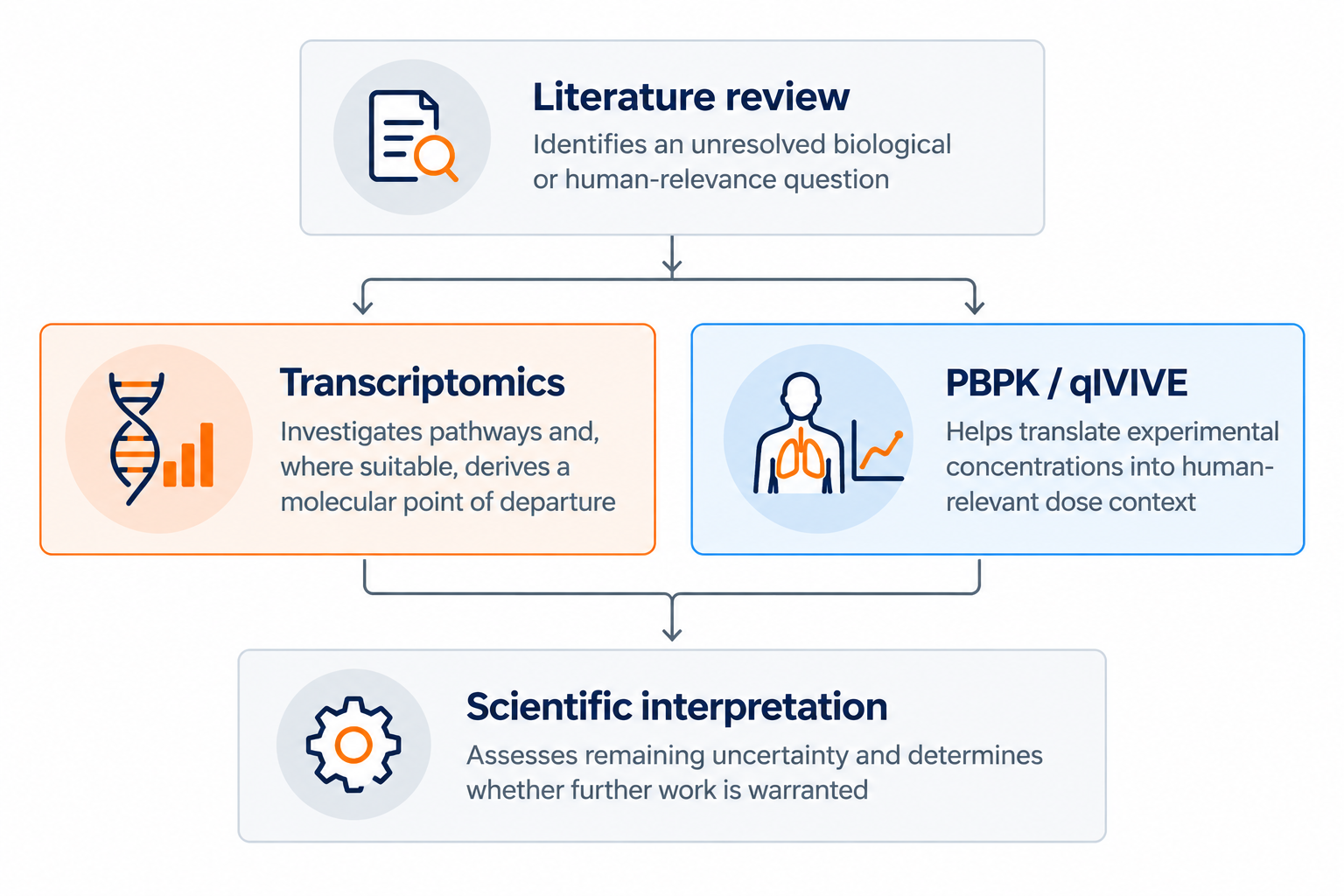
Figure 1. Integrating literature synthesis, transcriptomics, and PBPK/qIVIVE to address toxicological data gaps in a tiered approach to safety assessment.
Once a data gap has been identified, scientists can consider the most appropriate next step based on the uncertainty and its importance to the safety assessment. This may include:
- No further investigation: The existing evidence is sufficient to support a decision.
- Reanalysis of existing data: Available information could be examined further to address specific uncertainties.
- Transcriptomics or PBPK modeling: Additional analysis could help clarify biological responses or human exposure relevance.
- Targeted testing: New experimental data may be needed to address an important gap.
- Ongoing monitoring: Emerging research could be reviewed as new evidence becomes available.
Not every assessment needs to progress through every tier. The aim is to select the most appropriate next step based on the available evidence and the decision being made.
How Can ScitoVation Help?
At ScitoVation, a tiered approach is central to how we help scientists address toxicological data gaps. We combine expert-led literature reviews with computational toxicology tools to help teams understand the available evidence, identify important uncertainties, and determine the most appropriate next steps.
Our Information Synthesis service combines ScitoVation’s scientific expertise with ScitoSim™ to support literature reviews, evidence evaluation, and expert interpretation. For teams looking to investigate specific gaps further, our Transcriptomics module within ScitoSim™ enables computational scientists and bioinformaticians to analyze their own data and explore biological responses, with expert support available from our scientists when needed. We also offer PBPK and qIVIVE modeling through ScitoSim™. This can be carried out by our experts or by experienced modelers who prefer to carry out their own analyses.
We provide a flexible, scientifically informed approach for moving from evidence gaps to defensible safety decisions, without requiring every assessment to follow the same path.
Final Thoughts
Identifying a data gap does not mean a literature review has reached a dead end. These gaps can help scientists understand where uncertainty remains and whether additional evidence is needed to support a safety decision.
Transcriptomics, PBPK modeling, and qIVIVE can help address different questions, such as understanding biological responses and assessing human exposure relevance. The key is to focus on the uncertainties that matter most and choose the next step based on the evidence available.
Has your toxicological literature review identified an important data gap? ScitoVation combines expert-led Information Synthesis with transcriptomics, PBPK, and qIVIVE capabilities to help you evaluate the evidence and identify appropriate next steps. Talk to our scientists.
FAQs
What is a data gap in a toxicological literature review?
A data gap is an area where scientific evidence is missing, insufficient, conflicting, or unable to answer a specific safety question. These gaps may relate to biological mechanisms, dose-response relationships, exposure, or human relevance. Whether the gap needs further investigation depends on its importance to the safety or regulatory decision.
Does every data gap require additional toxicological testing?
Not always. When a gap is identified, this does not automatically mean new testing is needed. Scientists must first consider whether the uncertainty could affect the safety assessment. Then, depending on the findings, existing data may be sufficient, or further analysis, transcriptomics, PBPK/qIVIVE modeling, targeted testing, or ongoing monitoring may be appropriate.
How can transcriptomics help investigate biological data gaps?
Transcriptomics examines changes in gene expression following chemical exposure. It can help scientists investigate affected biological pathways, explore possible modes of action, and assess molecular dose-response relationships. However, changes in gene expression do not necessarily indicate an adverse effect and must be interpreted alongside other toxicological evidence.
How can PBPK and qIVIVE help assess human relevance?
PBPK modeling helps scientists understand how a chemical moves through the body and how external exposure relates to internal dose. qIVIVE can help translate concentrations associated with biological activity from in vitro studies into estimated human-equivalent exposures or doses. These approaches can provide additional context for interpreting experimental findings in relation to human exposure.
How do scientists decide which approach to use after a literature review?
The next step depends on the type of data gap, the available evidence, and the safety or regulatory question being addressed. Scientists consider whether additional information will likely improve the confidence in the assessment or change the decision. A tiered approach helps identify the most appropriate method without requiring every assessment to undergo further testing or modeling.
References
- Barutcu AR, Black MB, Nong A. Mining toxicogenomic data for dose-responsive pathways: implications in advancing next-generation risk assessment. Front Toxicol. 2023;5:1272364. doi:10.3389/ftox.2023.1272364
- Barutcu AR, Black MB, Andersen ME. Transcriptomic re-analyses of human hepatocyte spheroids treated with PFAS reveals chain length and dose-dependent modes of action. Toxicology and Applied Pharmacology. 2024;489:117013. doi:10.1016/j.taap.2024.117013
- Barutcu AR, Scaglione J, Moreau M, et al. Nitroparaffin transcriptional profiles and toxicokinetics support chemical-specific carcinogenicity assessment. Regulatory Toxicology and Pharmacology. 2026;166:106035. doi:10.1016/j.yrtph.2026.106035
- Mallick P, Moreau M, Song G, et al. Development and Application of a Life-Stage Physiologically Based Pharmacokinetic (PBPK) Model to the Assessment of Internal Dose of Pyrethroids in Humans. Toxicological Sciences. 2020;173(1):86-99. doi:10.1093/toxsci/kfz211
- Moreau M, Antonijevic T, Hall JC, Fisher J. In vitro and computational approaches to predict developmental toxicity: Integrating PBPK models with cell-based assays. Toxicology and Applied Pharmacology. 2025;502:117435. doi:10.1016/j.taap.2025.117435
- Moreau M, Simms L, Andersen ME, et al. Use of quantitative in vitro to in vivo extrapolation (QIVIVE) for the assessment of non-combustible next-generation product aerosols. Front Toxicol. 2024;6:1373325. doi:10.3389/ftox.2024.1373325
- Andersen ME, McMullen PD, Phillips MB, et al. Developing context appropriate toxicity testing approaches using new alternative methods (NAMs). ALTEX. 2019;36(4):523-534. doi:10.14573/altex.1906261